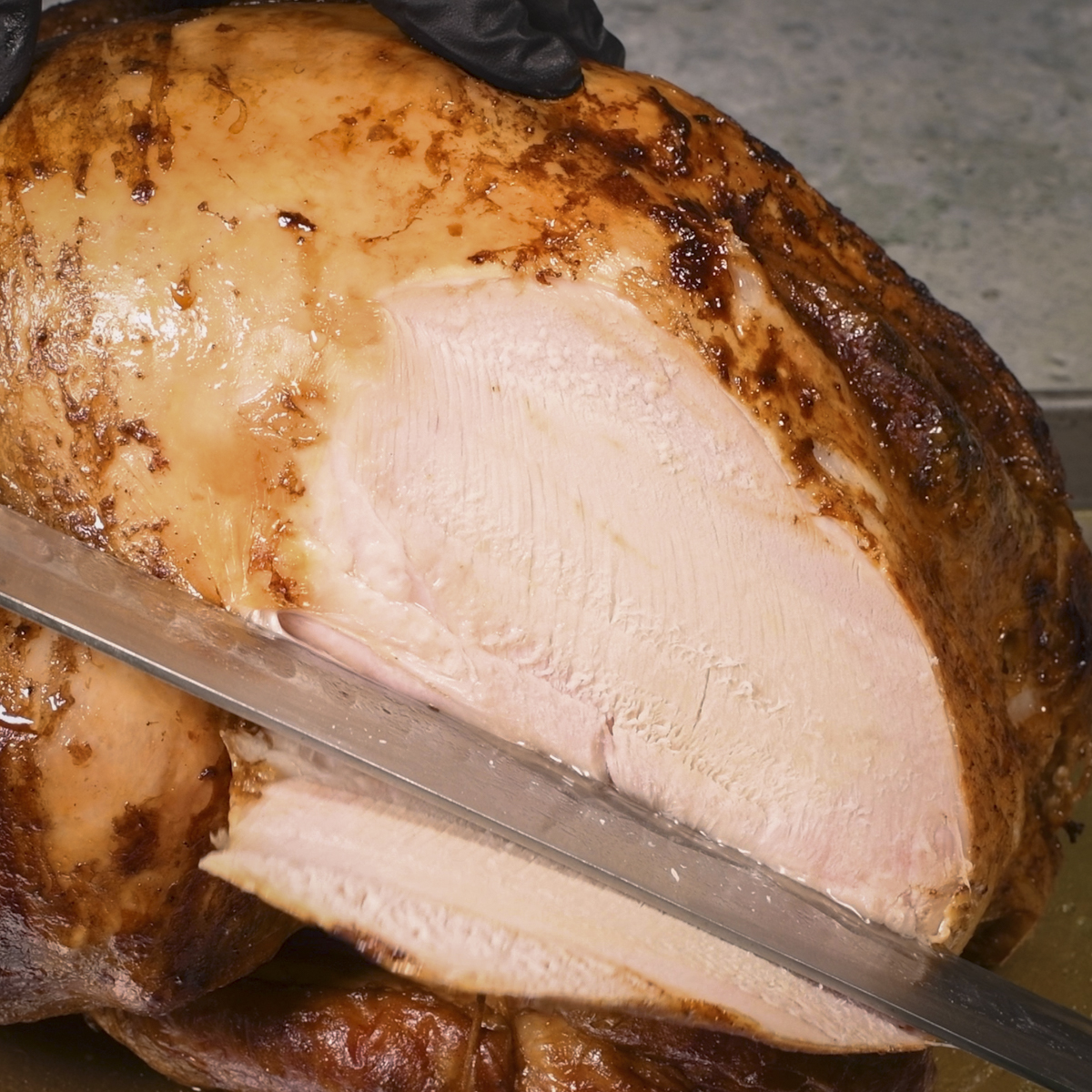
Rotisserie Turkey on a Kamado Joe Recipe
The JoeTisserie makes it easy to roast a turkey on a Kamado Joe. The JoeTisserie is a motor-driven rotisserie attachment for the Kamado Joe that includes a ring, a metal spit, forks that hold the bird, and a motor that slowly turns the spit. It is a great way to prepare a Thanksgiving turkey with juicy breast meat, golden brown skin, and light charcoal flavor
Servings 8 Servings
Calories 473kcal
Cost $25
Equipment
- Kamado Joe
- Kamado Joe Joetisserie
- Butcher's twine
- Meat trussing needle
Ingredients
Brine
- 2 quarts vegetable stock low sodium
- 1 cup Diamond Crystal kosher salt
- ½ cup brown sugar
- 1 onion quartered
- 1 tablespoon black peppercorns
- 2 bay leaves
- A few sprigs of fresh rosemary
- 3 garlic cloves smashed
- 6 quarts ice water
Turkey
- 1 whole turkey fully thawed, 12 to 15 pounds
- 1 onion quartered
- Canola oil for a light coating
- Kosher salt and freshly cracked black pepper
- 1 apple sliced
- 5 sprigs fresh sage
Instructions
Brine the Turkey
- Combine the vegetable stock, kosher salt, brown sugar, onion, peppercorns, bay leaves, rosemary, and garlic in a large pot. Bring the mixture to a boil and cook for two minutes, stirring to dissolve the salt and sugar. Remove it from the heat, let it cool, and stir in the ice water. Check that the finished brine is 40°F or below before adding the turkey.
- Remove and discard the neck and giblets from the thawed turkey, then place it neck end down in a large food-safe container. Pour in the chilled brine, making sure the turkey is fully submerged, then cover and refrigerate for 24 hours.
- After 24 hours, remove the turkey, discard the brine, and pat the bird thoroughly dry with paper towels. Thorough drying also helps the skin brown and crisp during the cook. Per USDA guidelines, do not rinse raw poultry because splashing can spread bacteria.
Roast the Turkey
- Place the turkey on a rimmed tray or roasting pan. Place the onion, apple slices, and sage loosely inside both cavities and sew them closed with butcher’s twine. Rub the skin with a light coating of canola oil and season with black pepper and kosher salt.
- Some turkeys have a plastic leg holder installed that can burn or catch fire over hot charcoal. If installed, remove the plastic leg holder.
- Tie the legs together with butcher's twine. Then, turn the turkey breast side down, fold the wing tips against the wings, and use butcher’s twine to tie the wings together close to the body. Trim the dangling ends of butcher’s twine.
- Slide the spit rod through the turkey, neck to tail, positioning it closer to the breast than to the back. The goal is to distribute the weight around the spit so the motor can rotate the turkey smoothly. Push one fork firmly into the thighs and the other fork into the breasts, then tighten the thumbscrews.
- Before lighting the grill, install the spit in the JoeTisserie, turn on the motor, and watch the turkey complete several full rotations. If the bird turns unevenly or the speed changes throughout the rotation, sometimes fast, sometimes slow, the turkey needs to be adjusted on the spit. Also check to make sure the turkey is centered left to right in the Kamado Joe and that it clears the dome thermometer probe when rotating.
- Remove the turkey and spit. Place the mounted turkey on a rimmed tray and cover it with foil while the grill preheats. Keep the total preparation and waiting time out of refrigeration under two hours, or one hour when the surrounding temperature is above 90°F.
- Bank the charcoal up the back of the charcoal basket and light. Do not use a drip pan or wood chunks.
- After lighting the charcoal, close the lid and use the dome thermometer and vents to establish 325°F. Alternatively, use a FireBoard temperature controller to monitor and control the temperature. Insert a FireBoard ambient probe through the top vent, approximately level with the dome thermometer, then set the FireBoard to 325°F. With either method, hold the grill at 325°F for about 20 minutes to warm the ceramic thoroughly before placing the turkey back in the JoeTisserie.
- Insert a wireless meat probe, such as a Typhur or Meater, into the thickest part of the breast, keeping it away from bone, following the insertion depth and heat limit instructions.
- Position the turkey and spit correctly on the JoeTisserie. Start the motor, and confirm that the turkey rotates freely before closing the dome. Monitor the wireless breast probe and the grill temperature throughout the cook.
- For crispier skin, cover the wings with foil when the breast reaches 150°F, then increase the cooking temperature to 425°F for approximately the final 15 minutes.
- Cook until the wireless probe in the thickest part of the breast measures 160°F, about 2.5 to 3.5 hours for a 12-to-15-pound turkey. When the internal temperature reaches 160°F, stop the rotation briefly and double check with an instant-read thermometer in the thickest part of the breast and the innermost parts of the thigh and wing, avoiding bone. Confirm that the thigh and wing have reached at least 160°F before removing the turkey. Carryover cooking continues to raise the breast temperature about 5°F during the rest.
- Remove the turkey from the Kamado Joe and place it in a large roasting pan and cover it with foil. Leave the spit rod and forks in place. Let the turkey rest for 20 minutes to allow the juices to redistribute. Keep the wireless probe in the breast during resting. Before carving, verify 165°F in the thickest part of the breast and the innermost parts of the thigh and wing with an instant-read thermometer, avoiding bone. If any location stops rising below 165°F, return the turkey to the JoeTisserie and continue cooking until that temperature is verified.
- Before carving, verify 165°F in the thickest part of the breast and the innermost parts of the thigh and wing with an instant-read thermometer, avoiding bone. If any location stops rising below 165°F, return the turkey to the JoeTisserie and continue cooking until that temperature is verified.
- After resting for 20 minutes and verifying the required temperatures, remove the spit, forks, and butcher’s twine. Discard the aromatics, then carve and serve.
Nutrition
Serving: 6ounces | Calories: 473kcal | Carbohydrates: 5g | Protein: 70g | Fat: 18g | Saturated Fat: 5g | Polyunsaturated Fat: 5g | Monounsaturated Fat: 6g | Trans Fat: 0.2g | Cholesterol: 232mg | Sodium: 411mg | Potassium: 769mg | Fiber: 1g | Sugar: 3g | Vitamin A: 209IU | Vitamin C: 1mg | Calcium: 68mg | Iron: 3mg